
5 Critical Defects That Signal Your Industrial Rail Spur Needs Immediate Repair
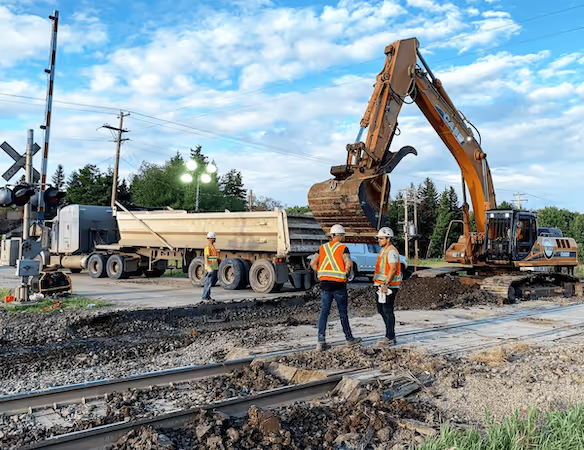
If your facility operates a private industrial rail spur, track maintenance is not just an operational preference; it is a strict safety and compliance requirement. Under Transport Canada’s Track Safety Rules, private spur owners are responsible for maintaining track geometry, ties, and turnout hardware on their property.
Catching minor track issues during routine site walks prevents costly derailments, unexpected track shutdowns, and emergency shipping delays.
Here are the 5 critical physical defects every plant manager, logistics coordinator, and safety inspector should look for on their trackbed.
1. Wide Gauge (Rail Spreading)
Standard track gauge across Canadian rail networks is 1,435 mm (56.5 inches), measured 16 mm below the top of the rail head. On Class 1 and Class 2 industrial trackage, Transport Canada limits maximum allowable gauge widening to 1,460 mm.
What it looks like:
- Spikes pulling out or lifting away from tie plates.
- Tie plates cutting deep into timber ties or shifting outward under load.
- Bright, polished metal marks on the inner edge of tie plates where rail bases are creeping.
Why it is critical:
As freight cars move across worn or rotted ties, dynamic loads push the rails outward. If gauge spreads beyond allowable tolerances, freight car wheel flanges drop between the rails. A drop-between derailment inside an active facility damages subgrade, destroys ties, and halts plant loading operations for days.
2. Ballast Fouling & Drainage Failure
Ballast is crushed angular stone packed beneath and around timber or concrete ties. Its job is to drain water away from the track structure, distribute heavy axle loads across the subgrade, and hold track in proper alignment.
What it looks like:
- Standing water sitting on top of crushed stone long after rain stops.
- Mud, clay, or spilled material filling the voids between ballast stones.
- Mud pumping: Grey or brown slurry squeezed up around ties as locomotives cross.
Why it is critical:
Fouled ballast traps moisture around wooden ties, accelerating wood rot and spike loosening. In Western Canada, trapped moisture expands during freeze-thaw cycles, causing severe track heaving and lateral track displacement. If your ballast cannot drain, your subgrade will fail beneath heavy car loads.
3. Cracked or Loose Joint Bars
Joint bars (fishplates) are the steel plates bolted on either side of a rail joint to join rail sections together. They maintain horizontal and vertical alignment where rail ends meet.
What it looks like:
- Visible cracks propagating from bolt holes or along the center web of the bar.
- Missing, loose, or sheared joint bolts.
- Vertical movement (dipping) at the rail joint when car wheels pass over.
Why it is critical:
A cracked joint bar under cyclic heavy loading quickly leads to a complete rail break. Transport Canada regulations require immediate speed restrictions or out-of-service flags for broken bars. Joint bar inspections require close visual checks - cracks often hide beneath surface rust and road dirt near the joint web.
4. Switch Point Gapping
The switch point is the tapered, movable rail section at a turnout that guides wheel sets from one track to another. When lined against the stock rail, the switch point must seat flush.
What it looks like:
- A visible gap between the tapered switch point and the main stock rail when fully thrown.
- Ice, gravel, or spilled facility product packed into the switch heel or point assembly.
- Bent switch rods or damaged switch stands.
Field Check:
With the switch lined, attempt to insert a standard 3/8-inch gauge block between the point and stock rail. If the block slides in without resistance, the switch is out of tolerance.
Why it is critical:
A gapped switch point invites wheel flanges to "pick the switch." When a flange catches the gap instead of riding smoothly through, the car splits the turnout, causing instant derailment at the switch stand.
5. The "3-Tie Rule" (Decayed or Split Ties)
A single degraded tie requires scheduled replacement during regular maintenance. However, multiple consecutive failed ties create an emergency structural defect.
What it looks like:
- Concealed wood decay: A screwdriver or metal probe penetrates more than 3/4 inch into the timber.
- Severe longitudinal splits running end-to-end through the tie.
- Crushed timber where tie plates have sunk deep into the wood fibers.
- Loose spikes that slide out by hand.
The Regulatory Threshold:
Under Transport Canada rules, three consecutive defective ties in a row represent a mandatory out-of-service condition or severe speed restriction. Without three solid, load-bearing ties in sequence, the rail loses structural support and spreads under heavy axle weights.
What to Do If You Find These Defects
If your site inspection turns up wide gauge, switch gapping, or consecutive tie failure, take immediate action:
- Restrict Traffic: Limit train speeds over the affected section or flag the track out of service.
- Document the Location: Note exact switch numbers, joint locations, or tie counts.
- Schedule a Certified Track Inspection: Have a qualified track inspector verify structural integrity and map out repair steps.
Quality Railway Services provides certified track inspections, scheduled maintenance, and 24/7 emergency rail repair across Alberta, British Columbia, and Saskatchewan. Our crews handle tie replacements, switch repairs, turnout installations, and geometric surfacing to keep your facility compliant and operational.
Discovered a critical track defect on your spur?
Call our 24-hour dispatch line at 1 (855) 724-5777 or contact Quality Railway Services online for immediate mobilization.
Ready to work with Quality Railway Services?


